Finnish Lapland, Fell by Fell
Finnish Lapland has no fjords and few dramatic peaks. What it has is space: rolling fells, endless spruce and pine forest, frozen lakes and very little artificial light. For many first-time visitors, that quiet is the whole point.
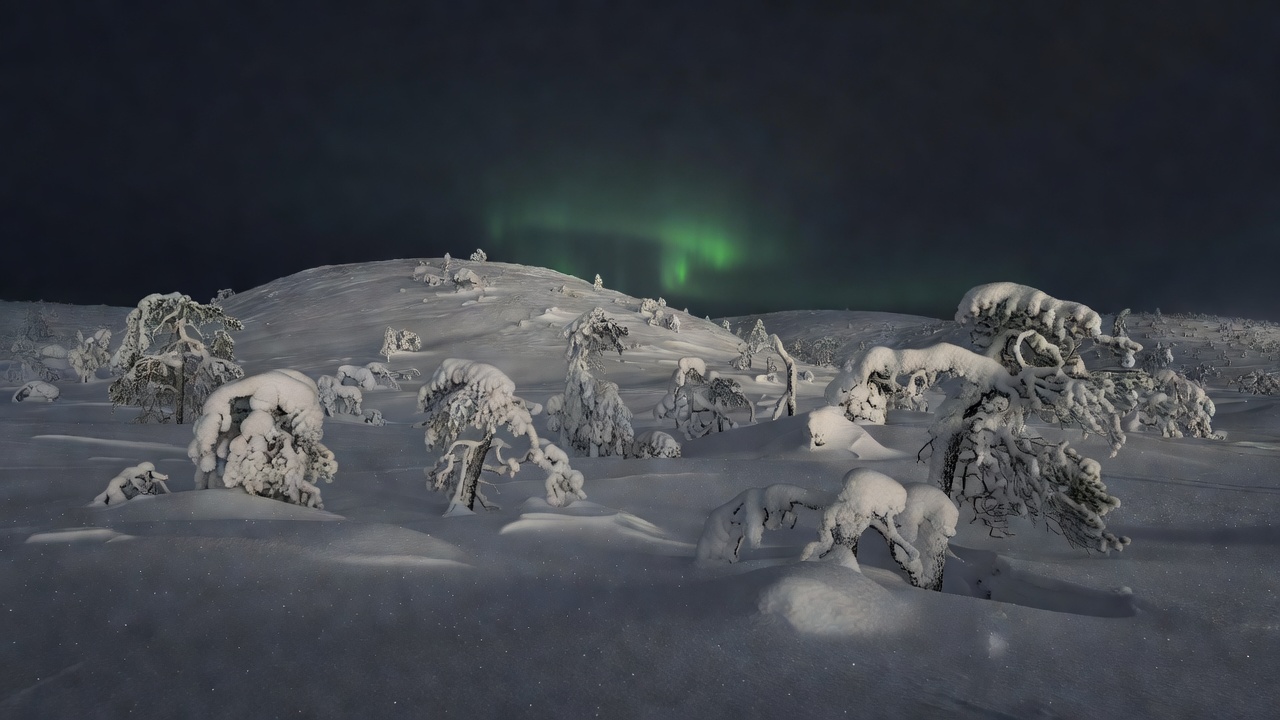
Why the Fells Work So Well
A fell, or tunturi in Finnish, is a rounded hill that rises above the tree line. Climb one, even only a few hundred metres, and you get a full 360-degree view of the northern sky, above any mist lying in the valleys. Finland's interior climate is also more continental than Norway's coast. Winters are colder and, on many nights, calmer and clearer.
The Finnish Meteorological Institute has studied the aurora for a long time, and its observations show that in northern Lapland the lights appear on most clear, dark nights during the season. The phrase to remember is clear and dark. The aurora is common up here. Cloud is what you are really planning around.
The road network is also kind to chasers. Roads are flatter and less blocked by water than in Norway, so if cloud covers one area, a drive of an hour or so in another direction is often possible.
Bases in Finnish Lapland
Saariselkä and Kiilopää
A compact resort village at the edge of Urho Kekkonen National Park, one of the largest national parks in Finland. Kaunispää fell rises right above the village, and the open summit of Kiilopää, a short drive south, is one of the darkest easy-access viewpoints in the country.
Inari
The heart of Finnish Sámi culture, with the Siida museum and nature centre and the Sámi cultural centre Sajos. Lake Inari, a vast frozen lake dotted with islands, gives a flat, open northern horizon.
Utsjoki and Nuorgam
Finland's northernmost municipality, along the Teno River on the Norwegian border. Remote, very dark and quiet, with the oval often directly overhead.
Levi
One of Finland's biggest ski resorts, with many places to stay. The slopes are floodlit in the evening, so walk or drive away from the centre for real darkness.
Pallas-Yllästunturi National Park
A chain of fells running north to south between Levi and the Swedish border, with Pallastunturi among the best-known peaks. Muonio and Äkäslompolo make good bases nearby.
Kilpisjärvi
At the tip of Finland's north-west "arm", beneath the distinctive Saana fell and close to the Three-Country Cairn where Finland, Sweden and Norway meet. It is Finland's highest settlement and among the darkest places in the Nordics, but mountain weather here can change quickly.
Rovaniemi
Lapland's capital, right on the Arctic Circle, with the Arktikum science museum and the easiest connections. The town is bright, so head to Ounasvaara hill or the forests beyond. Being further south, it needs somewhat stronger activity than the far north.
Sodankylä
A small town between Rovaniemi and Saariselkä, home to the Sodankylä Geophysical Observatory. A quiet stop on the road north with plenty of dark forest close by.
Glass Roofs, Cabins and Honest Expectations
Finland is known for accommodation with glass roofs, and they are a cosy way to watch from bed. Keep two things in mind. Glass can frost over or collect snow, and indoor reflections hide faint aurora. A traditional log cabin with a door that opens onto dark forest gives you the same sky, often at a quieter pace.
The Finnish Meteorological Institute's Auroras Now! service shows magnetometer readings from stations across Finland in near real time. When the lines start to wobble, it is time to put on your boots.
Useful sources: Finnish Meteorological Institute: auroras and space weather (opens in new tab) · Nationalparks.fi (opens in new tab) · Visit Finland (opens in new tab)